
Strolling Through Lively Dotonbori, Osaka, as a Pair: Where Your Companion Will Stop and Stare, Plus Detours Before and After a Street Kart Tour
Strolling Through Lively Dotonbori, Osaka, as a Pair: Where Your Companion Will Stop and Stare, Plus Detours Before and After a Street Kart Tour
"Wait, wait, look at that!" In your first few minutes in Dotonbori, try counting how many times the person next to you says this. It's more fun than you'd expect.
Dotonbori, in Osaka's Minami district, is a place that never lets your eyes or nose rest. Look up and there are giant signs. Look down and there's the river. Turn your head and the smell of food drifts past. When two people visit together, they can be looking at the same scene and react in completely different ways. One has their phone out for a photo, and the other is already hunting for the takoyaki line. Part of the fun here is that mismatch.
This article walks you around Dotonbori with one question in mind: where is your companion likely to stop, and what face will they make? It also covers how to divide your time if you stop by Dotonbori before or after a tour at Street Kart Osaka in Minami-Horie. It's written for pairs who are in Osaka for a weekend, short on time, and still want to come home with good photos.
The Moment You Arrive in Dotonbori, Where Does Your Companion Look First?
Let me go off on a tangent for a moment. Chinese has a word, rènao (熱鬧), for a place that's crowded, noisy, and full of energy. Anyone who has walked through a night market in Taiwan knows that atmosphere is exactly what rènao means.
Dotonbori is rènao too, but it pulls your eyes in a different direction from a night market. At a night market the stalls sit at eye level, so your gaze stays horizontal the whole time. In Dotonbori your eyes get pulled upward. Signs jut out from the building walls, and before you know it, both of you are walking along with your heads tilted back. Bring a friend from Taiwan, and their first words will probably be, "Aren't these signs way too big?"
At this point companions tend to fall into one of two camps: people who want to stop and take in the whole scene, and people who want to keep moving. Neither is right or wrong. Just agree at the start: "Let's spend the first 10 minutes stopping to look around." That alone makes the pace much easier to manage for the rest of the walk. The streets are busy, so when you stop, step to the side of the walkway. That's basic courtesy here.
"Take My Picture" Starts at the Glico Sign
Any talk about photos in Dotonbori has to start with the Glico sign. It's a huge sign of a runner with both arms raised, and it's one of Osaka's best-known sights. Once you reach it, the companion who has talked about nothing but food until now will suddenly say, "Take my picture here." It's a classic moment on a trip for two.
Here are a few tips for the shot.
If you want the sign and your companion in the same frame, the photographer should step back a bit. Stand too close and you'll only catch the top half of the sign, and nobody will be able to tell where the photo was taken. Shoot vertically, with your companion in the bottom third and the sign in the top two-thirds. That ratio works as-is for Instagram Stories and for vertical posts on Xiaohongshu (RED).
Have your companion stand slightly to the left or right instead of in the center. That way the sign and their face don't overlap, and both come out clearly. Some people raise both arms to copy the sign's pose, but there's no need to push someone who feels shy about it. A profile shot of them gazing up at the sign often makes for a more natural, more emotional photo.
After dark, the sign's light falls on people's faces, so take a few shots with your phone's night mode on and off and compare. Sunset times change with the seasons, so I can't promise that a particular time will get you night photos. The surest approach is to check the color of the sky when you're there. If you edit your photos, lowering the exposure just slightly in Lightroom or VSCO helps keep the sign's colors from blowing out.
For hashtags, #道頓堀, #Dotonbori, and #大阪旅行 (Osaka travel) are the basics. If you're posting for friends in Chinese-speaking regions, it's handy that #大阪 and #道頓堀 work as-is in kanji. For people from places that use Chinese characters, being able to read a place name as-is is a small pleasure.
The Crab Sign, Kuidaore Taro, and Smells That Change Your Pace
Once the photo fever at Glico dies down, the next thing your companion reacts to might be the giant crab sign. Kani Doraku has an enormous crab mounted on the front of its building, and you can't help looking up as you walk by. Some people stop as if checking, "Wait, is that thing moving?" When that happens, don't rush them. Just look up with them.
Kuidaore Taro is another spot that gets companions excited. He's a drum-carrying doll known as a face of Osaka. People take souvenir photos with him, so if you want a shot of the two of you, try asking someone nearby to take it. You can say "Shashin, onegai dekimasu ka?" in Japanese, but English often works too. If you keep the conversation mode of a translation app open, it's less awkward even if someone says no.
And the biggest reason plans fall apart in Dotonbori is the smells. Sauce sizzling on a griddle, dashi broth, oil from something deep-fried. A new aroma drifts by with every step. Among shops whose locations could be confirmed from our sources, Dotonbori has takoyaki at Kukuru and ramen at Kinryu Ramen and Ichiran Dotonbori. On the Shinsaibashi side, there's also Mizuno for okonomiyaki.
On a trip for two, one person's craving and the other's hunger often don't line up. That's where the share-one-dish strategy comes in. If you split one boat of takoyaki between you, you'll still have room for the next place. It's the same idea as snacking your way through the small bites at a Taiwanese night market. Eating as you go and telling each other "hǎochī!" (delicious!) is a way of enjoying food that travelers from Asia will find familiar.
That said, foot traffic in Dotonbori moves fast. Eating while walking makes it easy to bump into people, so it's safer to step in front of the shop or to the side of the street and finish eating before moving on.
Tips for Walking with a Companion Who Doesn't Like Crowds
The bustle is a big part of Dotonbori's appeal. To be honest, though, it can be hard going for people who don't like crowds. If one of you is that type, there are a few things you can do.
First, use the Dotonbori River Walk along the water. It sits closer to the water than the main street, so the view opens up a little. Looking up at the signs from a different angle also gets you photos that differ from the ones you'd take on the street. The light from the signs reflects and ripples on the river, and that alone makes a picture. If your companion starts to look a bit worn out, stop on the river walk for a few minutes and watch the water. That can be enough to bring their smile back.
If you want somewhere even calmer, one option is to head over to Hozenji Yokocho. It's an area lined with kappo and Japanese restaurants, and according to our sources it's a 20-minute walk from Street Kart Osaka. Once you leave Dotonbori's rènao behind, the noise level changes completely. Your companion may be surprised by the contrast: "Is this really the same city?" This isn't a place for making noise, so when you take photos, stay considerate of the shops and the people around you.
One more important thing: decide in advance where to meet if you get separated. Dotonbori has so many landmarks that "in front of the Glico sign" can still leave you struggling to find each other in the crowd. Something specific like "this side of this bridge, the end closer to the river" is more reassuring. Turn on location sharing on your phones too.
How Does Osaka's Minami District Look from a Kart Compared with on Foot?
Before or after enjoying Dotonbori on foot, there's another way to see the area: a street kart tour.
Street Kart Osaka is in Minami-Horie. Our sources list Amerikamura, Shinsaibashi, Dotonbori, and Namba as areas the Osaka tours pass through. The route follows the guide's lead. It's easier to plan if you think of your free time wandering on foot and your time driving a kart as two separate things.
The signs and buildings you looked up at on foot will probably look different from a kart. The wind hits your cheeks, and the sounds of the city reach your ears along with the engine. The rows of vintage clothing shops in Amerikamura, the entrance to the Shinsaibashi arcade, the wide avenues of Namba. Watching scenery you saw on foot rush by at speed is a completely different feeling from walking.
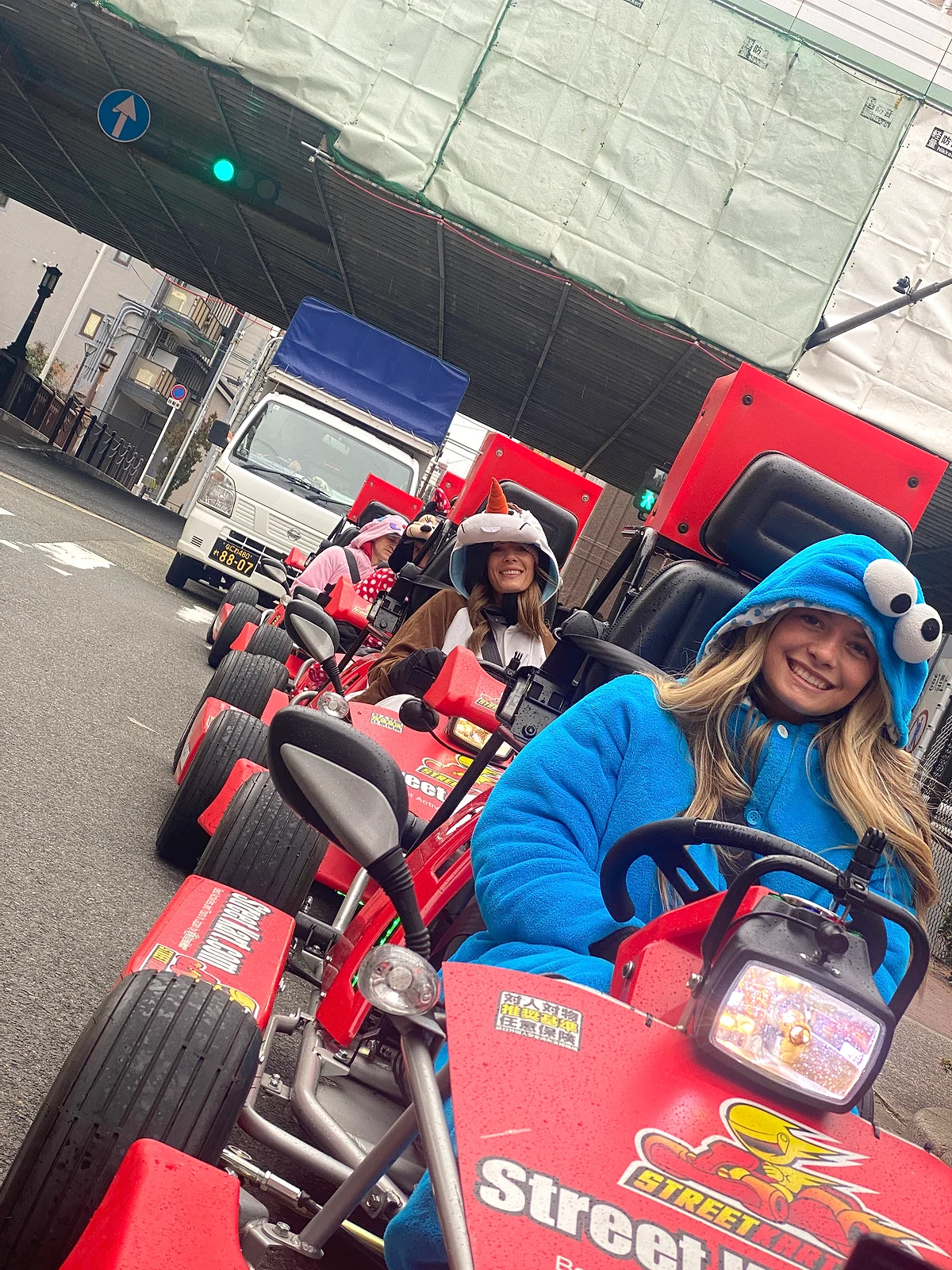
The good news for pairs is that the karts are single-seaters. You can't ride together, so each of you takes the wheel yourself. Nobody ends up just watching from the passenger seat. If your companion is driving ahead of you, you'll see Osaka over their shoulder. After the tour, comparing notes ("Did you see that corner?") is part of the fun.
About photos, there's one thing I want to stress: don't touch your phone while driving. Focusing on driving comes first. If you want photos of Dotonbori, the basic approach is to take them on foot before or after the kart ride. Save the Glico sign and the riverside scenery for your walking time, and take your time with them.
Why People Choose Street Kart
Here's a rundown of what Street Kart offers as an experience to pair with the Dotonbori area.
First, it's a guided tour. Street Kart tours are led by trained guides. When you drive, you follow Japanese traffic laws and the guide's instructions.
Second, guidance on the day of the tour is basically in English. Guidance in Japanese or other languages depends on the staff that day and isn't guaranteed. If this matters to you, please check the official website for details.
Third, the website is available in 22 languages. This is about the website, separate from the language used on tour day. Before booking, each of you can open the pages in whichever language is easiest to read.
Fourth, there's the track record. As of November 2023, across all locations combined, Street Kart had run more than 150,000 tours for more than 1.34 million customers, with more than 20,000 reviews and an average rating of 4.9/5.0. These are November 2023 figures, not current ones.
Fifth, there's the Osaka location. Minami-Horie is an area full of stylish shops and cafes. Amerikamura, with Triangle Park and rows of vintage clothing shops, is about a five-minute walk from the store. Just wandering around here before or after your tour gives you a different side of Osaka from Dotonbori.
Sixth, both of you get to drive. As mentioned in the previous section, the karts are single-seaters. Your trip memory won't be "one of us drove and the other rode along." It'll be "we both drove." For a pair traveling together, that turns out to be a bigger difference than you might expect.
Street Kart has nine locations in Japan (seven in Tokyo, one in Osaka, and one in Okinawa), and the only Osaka store is in Minami-Horie. Please check the Street Kart official website for full tour details.
Short on Time? Should Dotonbori Come Before or After the Tour?
This is probably what pairs visiting Osaka for the weekend struggle with most. The short answer is that both options have their merits. The smoothest way to decide is based on your companion's personality.
If you put Dotonbori before the tour: walking around first to see the signs and the river means that when you drive near them in the kart, you'll recognize the spots ("That's where we just were!"), which makes it more fun. The downside is the risk of getting so absorbed in snacking that you barely make the meeting time. According to our sources, it's a 20-minute walk from Dotonbori to Street Kart Osaka, so leave plenty of extra time to get there. Move with time to spare so you're not late for check-in.
If you put Dotonbori after the tour: you can focus on food and photos without watching the clock. Walk into Dotonbori with the thrill of the drive still fresh, and the conversation will flow: "The place we drove past is just up ahead, right?" You'll probably be hungry after the tour, so heading straight for takoyaki at Kukuru or Kinryu Ramen is a solid option. Or walk a little farther to Chibo, about 10 minutes on foot from the store, for okonomiyaki.
Tour length and departure slots vary by plan and season, so I can't give fixed times here. Please check the official website before booking. Then decide on the tour time first and fit Dotonbori into the time that's left. Planning in that order makes it less likely your two schedules will clash.
What to Check Together Before Booking
Finally, here's what the two of you should confirm before you set out.
First, driver's licenses. Participants must be 18 or older and hold a valid license that allows them to drive a car. The required documents depend on the country that issued your license and the type of license. Digital licenses aren't accepted, so you'll need the original paper license. If you don't have the required documents on the day, you can't take part and won't get a refund. Check in advance that both of you meet the requirements on the official driver's license page. If only one of you turns out to be eligible, your travel plans will fall apart. Please check the official website for details.
Next, booking timing. Weekends fill up quickly, so if you're on a weekend trip, book early. Bookings are accepted via Facebook, LINE, and email. Please see the official website for details.
For getting there, use public transportation. The store has no parking. The nearest station is Nishi-Ohashi on the Osaka Metro Nagahori Tsurumi-ryokuchi Line, a 3-minute walk away, and it's a 5-minute walk from Yotsubashi Station on the Yotsubashi Line. It's 12 minutes on foot from Shinsaibashi Station and 15 minutes from Namba Station, so you can also walk over from the Dotonbori side.
Prices vary by season and time of day, so please check the official website (kart.st) for current rates.
Walking Together, Driving Together in Osaka's Minami District
In Dotonbori, your companion's reactions become the map of your trip. The one who wants a photo at the Glico sign, the one who laughs looking up at the crab sign, the one who wants a quiet breather by the river. Every one of those reactions is part of what makes Dotonbori so lively.
Add a Street Kart tour, and you also get to see the same Minami district over a steering wheel. Photos you took on foot, and memories of driving yourself. Put those two side by side on the train home, and you won't be able to stop talking: "So that's what that sign looked like from the kart!" Whether you walk it or drive it, this busy city gives both of you memories to keep.
For tour details, start by checking the Street Kart official website. If you're going on a weekend, book early.
This article was originally written in Japanese and translated using AI. Some expressions may read unnaturally, and we appreciate your understanding. For the most accurate and up-to-date information, please refer to the official site at kart.st.
Street Kart is not affiliated with Nintendo or the Mario Kart series in any way. We do not provide costumes of Nintendo characters, and such costumes may not be worn during tours even if brought by participants.